
Perkins 1104C-44 Engine
From
£4,450 + VAT
Perkins 1104C-44 "RE" Build engine.
REMAN YOUR OWN ENGINE ONLY. NO SERVICE EXCHANGE.
The Perkins 1100 Series is a range of 3, 4, and 6-cylinder diesel engines with displacements from 3.3 to 7.0 litres and power outputs from 50 to 275 hp.
Launched in 2001 as a successor to the 1000 Series, the 1100 range was designed to meet EU Stage II/IIIA and US EPA Tier 2/Tier 3 emissions standards while delivering improved performance, fuel efficiency, and reduced noise levels.

All Perkins engines are built to order, please enquire for an idea of lead time. Prices are on an exchange basis.We require your old unit in return. If we do not have a suitable core available for rebuild, we will need to rebuild your own engine. All engines will be custom built to your spec, whether it has the industrial type block or stressed ("agricultural") block, top mount or side mount turbo options depending on your application.
The Perkins 1100 Series was introduced in 2001 following extensive research into the requirements of original equipment manufacturers.
The range was developed as a successor to the 1000 Series, building on its proven architecture while incorporating technologies to meet emerging emissions regulations and customer demands for quieter, more fuel-efficient engines.
The series comprises three main families: the 3-cylinder 1103 with a displacement of 3.3 litres, the 4-cylinder 1104 at 4.4 litres, and the 6-cylinder 1106 at 7.0 litres.
All variants share a common bore of 105mm, with a stroke of 127mm on the 1103 and 1104 models, and 135mm on the 1106. Power outputs range from approximately 50 hp to 275 hp depending on the model and aspiration type.
In 2003, Perkins introduced the 1100D range, an evolution of the original 1100 Series designed to meet EU Stage IIIA and US EPA Tier 3 emissions standards. This development brought further improvements in noise reduction, power density, and environmental performance.
The 1100 Series introduced several advancements that contributed to its widespread adoption across agricultural, construction, and power generation applications.
Emissions compliance. The range was designed from the outset with emissions regulations in mind. Initial models met EU Stage II and US EPA Tier 2 standards, while later 1100C and 1100D variants achieved Stage IIIA and Tier 3 compliance.
Mechanical and electronic fuel systems. The 1100 Series offers a choice of mechanical fuel injection or electronically controlled common rail systems. Electronic variants provide precise fuel delivery matched to engine load, improving efficiency and reducing emissions.
Reduced noise levels. Significant engineering effort went into minimising combustion and mechanical noise, addressing customer demands for quieter operation in agricultural and urban environments.
Extended service intervals. Standard 500-hour service intervals reduce maintenance requirements and downtime. Single-side service access to key components simplifies routine maintenance.
Common platform design. Shared front and rear mounting points, connection points, and components across the 1100 Series make it straightforward to install different engine variants within the same application. The platform also shares architecture with the later 1200 Series, easing the transition to Stage IV and Tier 4 Final compliance.
The 1100 Series uses a naming convention that indicates cylinder count and displacement:
1103 (3-cylinder, 3.3 litres): A compact engine popular in tractors and smaller industrial applications. Power outputs typically range from 36.9 to 58 kW (49 to 78 hp). Available in naturally aspirated and turbocharged variants.
1104 (4-cylinder, 4.4 litres): The mid-range option, offering power outputs from approximately 55 to 106 kW (74 to 142 hp). Widely used in construction equipment, agricultural machinery, and generators. Available with mechanical or electronic common rail fuel systems.
1106 (6-cylinder, 7.0 litres): The largest variant, delivering 112 to 205 kW (150 to 275 hp). Suited to heavy-duty applications including excavators, wheeled loaders, large generators, and marine propulsion. Features turbocharged aftercooled aspiration as standard on most models.
Model codes include suffixes indicating aspiration and fuel system type. For example, 1104C-44T denotes a 4-cylinder mechanical turbocharged engine, while 1106D-E70TA indicates a 6-cylinder electronic turbocharged aftercooled variant.
The Perkins 1100 Series is found in equipment from a wide range of manufacturers across multiple sectors. Typical applications include:
The 1100 Series has been in production for over two decades and remains widely used in working machinery across the UK and globally. Its combination of proven reliability, strong parts availability, and familiarity among service engineers makes it a sensible choice for operators seeking to maintain or replace existing engines.
For equipment operating in regions with Stage II/IIIA or Tier 2/Tier 3 emissions requirements, the 1100 Series continues to offer a cost-effective solution. The common platform design also provides a straightforward upgrade path to the 1200 Series when higher emissions compliance is required.
Regular servicing is essential to maximise engine life and performance. The 500-hour service intervals and single-side access to filters and service points simplify routine maintenance.
Oil and filter changes, fuel system checks, and cooling system maintenance should be carried out in accordance with Perkins recommendations.
Genuine Perkins parts or quality aftermarket equivalents help ensure consistent performance and avoid premature wear.
When a full engine replacement is required, remanufactured Perkins 1100 Series engines offer a balance of reliability and value, rebuilt to original specifications using new or reconditioned components.
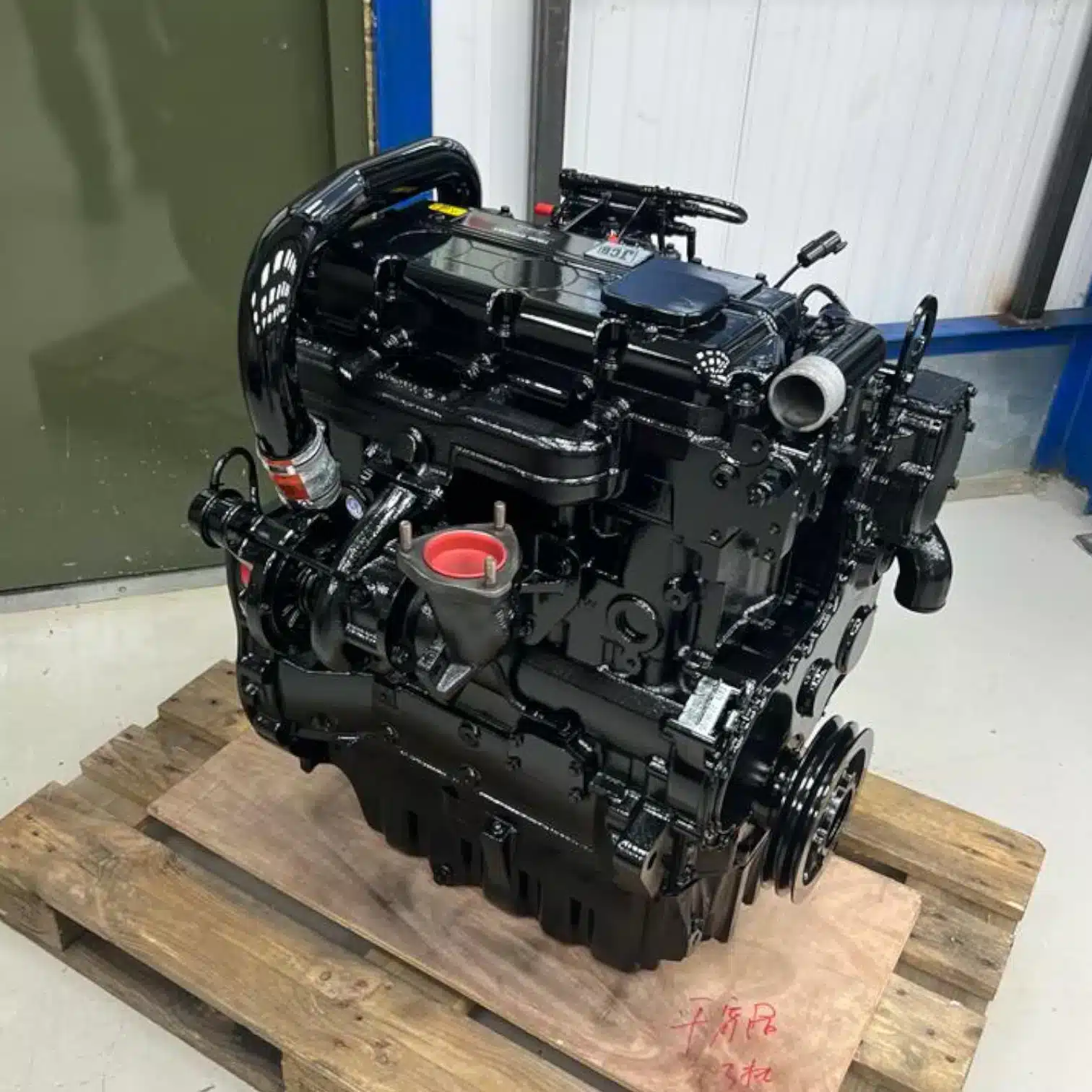


The engine block is bored back to standard with new liners fitted, cylinder head re-manufactured with valve seats re-cut and new valves fitted if necessary and crankshaft ground.
The fuel injection equipment is remanufactured and a reman turbo is also fitted (if applicable).
The engines are re-assembled in our clean workshop with new pistons and rings, bearings, oil pump, water pump, and all new gaskets fitted with all other components inspected and changed if necessary.
The engine is then dynamometer tested and painted ready for delivery.
We are members of the Federation of Engine Re-manufacturers.
Therefore our remanufactured engines are required to meet a certain standard under BSI AU 257:2002, set by British Standard Automobile Series code of practice.

Timik Agricultural Ltd, Church House Farm, Clewers Hill, Waltham Chase, Southampton, SO32 2LN, United Kingdom